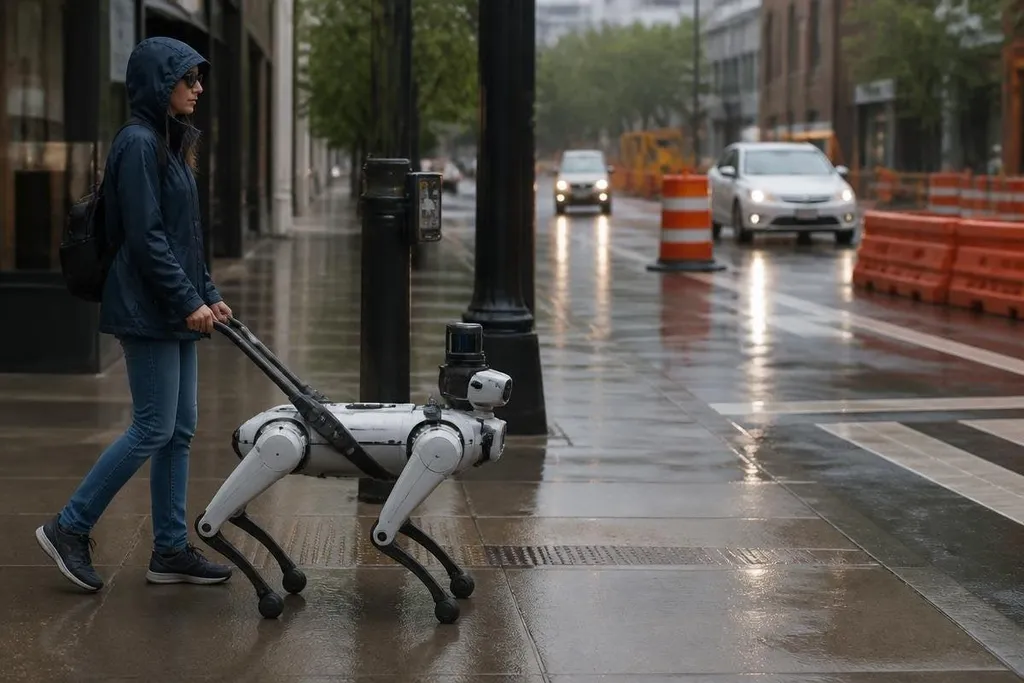
A robotic guide dog has to do far more than avoid obstacles in a controlled test. It must help one person reach a destination safely when curbs, crowds, weather, doors, and street works change the route.
For anyone assessing this technology, the useful question is simple: can the robot make a safe choice when its map and sensors disagree?
- The job: guide a person through changing spaces
- The proof: safe choices during ordinary trips
- The limit: a failure can affect a person directly
How guidance would work
A guide robot would need cameras, depth sensors, and location tools to build a view of the path ahead. It could use that view to spot a curb, a pole, a doorway, or a person moving across the route.
The robot would then need to turn those findings into clear actions. It might stop, change direction, slow down, or ask the person to confirm a choice through sound, vibration, or a handle control.
That last step matters. A robot can detect an object without knowing what the person needs next.
A low barrier may be easy to step over for one person and unsafe for another, so the robot needs a way to learn the user's walking speed, balance, and preferred routes.
Route planning adds another problem. A map may show a path, but it won't always show a delivery van blocking the pavement or a temporary barrier near a crossing. The guide system needs a safe response when it cannot read the space with confidence.
The person stays in charge
A robotic guide dog should help with movement without taking control away from the person using it. The person needs to know why the robot stopped, which direction it wants to take, and how to override that choice.
This calls for controls that work without a screen. A handle could give vibration signals for direction or danger. Spoken prompts could help in some places, but traffic noise and crowded streets can make audio hard to hear.
The robot also needs to work at the pace of the person walking. A route that looks short on a map may include stairs, a narrow pavement, or a crossing with little time to respond. Distance alone won't tell you if the route is usable.
That route test also needs evidence from daily travel, not a staged walk. Robot 24 reports can tie a guide robot’s route choice to the surface, crossing, stairs, and moments when a person had to take control. Those details lead to the next problem: what happens when the plan breaks.
Where the plan breaks
Outdoor travel brings changes that are hard to control. Rain can affect sensor readings. Bright sunlight can reduce camera performance. Crowds can block the robot's view, while construction can remove the path it planned to use.
A battery problem also becomes a safety problem if the robot stops far from home. Any serious system needs a clear low-power warning, a safe stop mode, and a way for the person to get help without relying on the robot's route plan.
Privacy needs a direct answer too. A guide robot may process images of streets, shop fronts, and people nearby. The maker should explain what the robot stores, what leaves the robot, and how long that information remains available.
I’d treat a robotic guide dog as a mobility aid under review, not a replacement for a trained guide dog until long outdoor trials show that it can handle failure safely.
Before a pilot starts
A trial team should check these points before putting a robot beside a person on public streets:
- Test changing routes: include blocked pavements, temporary barriers, open doors, and busy crossings.
- Set human control: give the person a clear stop command and a way to reject a route choice.
- Record failures: log missed objects, false stops, route changes, sensor errors, and low-power events.
- Check weather limits: state which rain, light, surface, and temperature conditions stop the trial.
- Plan recovery: define who answers a help request and how the person reaches a safe place.
- Protect nearby people: set rules for image storage, data transfer, and deletion.
The next useful proof won't be a smooth indoor walk. It will be a long, repeatable outdoor trial where the robot meets the same route after something changes, explains its choice, and leaves the person with a safe way forward.